

What does it take to build genuine confidence in your team?
Most corporate training courses never really answer that question. And even when they do, they feel generic and disconnected from the actual work people do. For many employees, these sessions become a “tick the box” activity rather than something meaningful.
At Authentic Transformation Academy (ATA), we use acting techniques to build authentic expression and confident communication in teams.
And we understand the problem: workplaces move fast nowadays, and change happens almost every day. Teams are dealing with new technology, artificial intelligence, and changing priorities all at once. Because of this constant pressure, they need something more meaningful than a simple “fun” team-building workshop.
In this guide, we’ll show you how our acting-based team building workshops can help build confidence, strengthen collaboration, and prepare for the demands of modern work environments.
We’ll start by showing how acting-based training encourages participation.
Why Acting-Based Methods Improve Employee Participation
Acting-based corporate training improves employee participation because people are active. Instead of watching slides, your team takes part and practises proper skills in the moment.
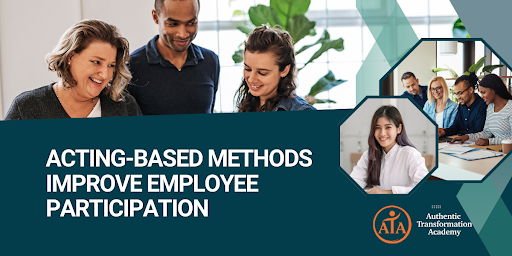
This hands-on experience makes the lessons feel real and easier to remember, so people stay engaged and are more likely to apply what they learn. Let’s look at why this method connects where others fall flat.
Why Traditional Corporate Training Courses Fail to Engage
Traditional corporate training courses, which usually rely on slide decks and lectures, might deliver information, but they don’t build emotional skills. Why? Because sitting and listening is a passive experience, and passive learning rarely sticks with people for long.
Research shows that learners forget up to 90% of what they hear within a week if they don’t actively use it. So all those hours spent in corporate training courses? Most of that knowledge disappears before it can improve daily performance or decision-making at work.
This is why so many employees lose interest in the training content during traditional workshops. They already know, deep down, that the content won’t stay with them.
What Acting-Based Methods Teach Teams
Acting-based training uses exercises like role-play and improvisation to practice workplace situations. For example, your team might act out a meeting with a difficult client or role-play a conversation where they need to give constructive feedback. These exercises put people in realistic scenarios, which helps them notice how they communicate and behave in the moment.
What’s more, that practice builds self-awareness, so team members understand how they come across to others during meetings or conversations. Then, adaptability lets them respond to changing situations with confidence instead of freezing up. And active listening improves naturally, since the participants must pay close attention to their colleagues to react effectively during the exercise.
These methods also teach collaboration under pressure, which is something most teams struggle with. Working through scenes together helps your team read body language, pick up on nonverbal cues, and communicate clearly even in tense situations.
Over time, these skills carry over to meetings, presentations, and difficult conversations at work.
Driving Real Employee Buy-In
The biggest difference with acting-based training is participation. People learn by doing, instead of watching someone else do it. This hands-on approach changes how employees learn, which helps them stay engaged, practise skills in real time, and retain what they experience during training.
Now, role-playing exercises in particular create a safe environment where people can try new approaches without worrying about real-world consequences. Because the stakes are low, employees feel more willing to experiment and take risks. This open-mindedness leads to deeper engagement. People start to feel the value of the training rather than just hearing about it from a facilitator.
We’ve seen teams go from sceptical to fully engaged in just one session at ATA. And experiencing growth firsthand this way gives employees confidence that they can bring back to their daily work.
How to Use Collaboration Tools Effectively in Teams
Collaboration tools only work when your team knows how to use them with trust and intention. You can have the best project management software in the world, but it won’t help if people are afraid to speak up or share honest feedback.
Here’s how to build the human skills that make collaboration tools actually useful.
The Reason Tools Don’t Improve Collaboration
Most teams already have plenty of collaboration tools, like project boards, shared documents, instant messaging, and video calls. While these tools make communication faster, they cannot build the trust and shared understanding that teams need to work well together.
Without that trust, team members may feel nervous about speaking up or asking questions, and no software can fix that. In fact, Google’s Project Aristotle (which studied hundreds of teams) found that psychological safety was the single most important factor for team effectiveness.
In other words, teams need emotional intelligence and mutual respect before any tool can actually help them work better together.
Human Behaviours That Boost Collaboration Tools
The best way to make collaboration tools useful is to build the right habits around them first. Knowledge sharing, for example, is much easier when people feel safe to ask questions and admit what they don’t know.
We recommend improv exercises from acting to help your team practise this kind of openness in a low-stakes setting. These exercises can include “Yes, and” agreement drills, short role-plays of asking for help, and status games that explore tone and power. This way, people will loosen up and start communicating more freely.
Clear norms for interaction are also very important. This means agreeing to give feedback respectfully, take turns speaking, and ask clarifying questions. If everyone agrees on how to give feedback and respond to each other respectfully, conversations will flow more smoothly. And there’ll be less second-guessing and fewer misunderstandings.
Psychological safety also sits at the centre of all of this. In fact, teams with high psychological safety are 31% more innovative and have 27% lower turnover rates.
Practical Elements of Effective Workshops
Good team building workshops provide structure that teams can bring back to their daily work (not just a fun afternoon out of the office). Things like ground rules, shared goals, and team rituals can help people stay on the same page long after the workshop ends.
The best exercises also reveal blind spots that teams might not notice on their own. For example, a group may overlook certain voices or let trust slowly break down. Acting-based activities create space for these patterns to surface so people can address them directly and honestly.
Long-Term Gains for Teams and Leaders
When collaboration skills improve, the benefits will show up across the whole organisation. Employee experience gets better because people feel heard and valued at work. Company culture also strengthens because teams actually enjoy working together rather than just tolerating each other.
These changes affect leadership outcomes as well. We’ve seen that teams who complete these workshops handle conflict more calmly and give feedback more openly and honestly. They also give feedback more openly and honestly.
Small changes like these might seem minor at first, but they add up to lasting success for the whole team.
Strengthen Your Team Performance and Culture with Better Training
So, what’s been your experience with team training so far? If past workshops felt forgettable or disconnected from work, you now understand what’s missing.
If your team training focuses on proper communication skills, it’ll lead to lasting results. We’re talking about better productivity, stronger employee satisfaction, and a workplace culture where people actually want to show up each day. But these results come from continuous improvement and ongoing personal development that builds over time.
The best team building workshops give employees skills they can practise every single day. And when people management improves at the leadership level, employee engagement follows naturally across the whole team.
So take a moment to think about your current approach. What might be missing? If you’re ready to build a team that communicates with confidence and authenticity, explore our programmes at Authentic Transformation Academy.
