

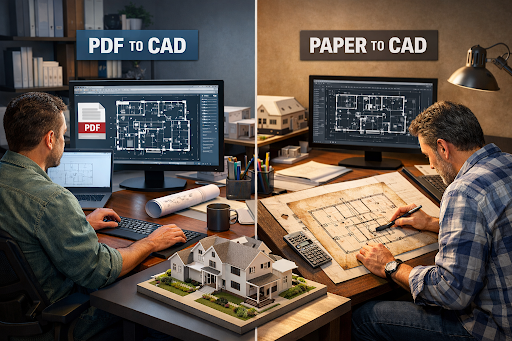
In today’s fast-moving construction and engineering landscape, time is money and accuracy is everything. Whether you’re a startup launching a new development, an architect renovating a heritage property in London, or a contractor managing a large-scale project in the USA, your drawings are the backbone of your workflow.
But here’s a common challenge:
What do you do when your design data exists only in PDFs or paper drawings?
Should you invest in PDF to CAD conversion services? Or are Paper to CAD conversion services the better fit for your project?
Choosing the right option can directly impact your project timeline, budget, and compliance standards. In this guide, we’ll break down the differences, explore current industry trends in the UK and USA, and help you decide which approach aligns best with your business goals.
Why Is CAD Conversion So Critical in Modern Projects?
Before comparing the two methods, it’s important to understand why CAD conversion matters.
According to a report by McKinsey & Company, large construction projects typically take 20% longer than scheduled and run up to 80% over budget. One key contributor? Poor documentation and outdated drawings.
Digitizing legacy plans into editable CAD formats helps:
- Improve design accuracy
- Enable BIM integration
- Reduce rework and change orders
- Ensure regulatory compliance
- Facilitate collaboration across teams
With the global CAD market projected to grow significantly over the next decade (as noted by Grand View Research), businesses across the UK and USA are increasingly investing in professional cad conversion services in USA and globally to stay competitive.
What Is PDF to CAD Conversion?
PDF to CAD conversion services involve converting digital PDF drawings into editable CAD formats such as DWG or DXF.
PDF files are commonly used for sharing architectural and engineering drawings because they’re easy to view and print. However, they are typically not editable in a meaningful way.
When you convert PDF to CAD:
- Vector data can often be extracted directly.
- Text and dimensions can be converted into editable layers.
- Drawings become fully modifiable in AutoCAD or similar software.
When Is PDF to CAD the Right Choice?
PDF to CAD conversion works best when:
- You already have digital PDF drawings
- The PDF contains vector-based data (not scanned images)
- You need quick revisions or updates
- You’re integrating into BIM workflows
- You want minimal manual redrawing
For startups and tech-driven construction firms in the UK and USA, PDF to CAD is often faster and more cost-effective compared to paper-based conversion.
What Is Paper to CAD Conversion?
Paper to CAD conversion services involve transforming physical drawings into digital CAD files.
This process typically includes:
- High-resolution scanning
- Image cleaning and enhancement
- Manual redrawing in CAD software
- Layering and standardization
Unlike PDF conversion, this method often requires more manual drafting work especially if the paper drawings are old, damaged, or hand-annotated.
When Should You Choose Paper to CAD Conversion?
Paper to CAD is ideal when:
- You’re working with legacy architectural drawings
- You’re renovating heritage or older buildings
- Your documents exist only in physical form
- Drawings include handwritten notes
- There are no digital backups available
In the UK, where many projects involve heritage buildings and historical archives, Paper to CAD conversion services are particularly valuable.
How Do Accuracy Levels Compare?
Is PDF to CAD More Accurate?
In most cases, yes especially if the PDF contains vector data. Vector-based PDFs allow partial automation, which reduces human error.
However, if the PDF is simply a scanned image embedded in a file, the process becomes similar to Paper to CAD conversion.
Is Paper to CAD Less Accurate?
Not necessarily but it requires skilled manual drafting.
Accuracy depends on:
- Drawing clarity
- Scaling precision
- Drafting standards applied
- Quality control processes
Professional customized cad conversion services ensure dimension verification and adherence to UK/USA drafting standards, minimizing risks.
What Are the Cost Differences?
Is PDF to CAD More Cost-Effective?
Generally, yes.
Because some data extraction can be automated, turnaround time is often shorter, and labor costs are lower.
Is Paper to CAD More Expensive?
Often, yes due to:
- Scanning requirements
- Manual redrawing
- Quality checks
- Potential reconstruction of missing details
However, for projects involving high-value real estate or compliance requirements, the investment pays off.
How Do UK and USA Trends Influence the Choice?
1. Growing BIM Adoption
According to the UK BIM Framework, BIM Level 2 adoption has become standard across public sector projects. The USA has also seen increasing BIM mandates across federal and state projects.
For BIM integration, clean CAD files are essential. PDF to CAD is often quicker for BIM-ready projects, while Paper to CAD is necessary for legacy building digitization.
2. Rise of Digital Twins
Digital twin adoption in construction is growing globally. Research from Deloitte highlights that digital twins can significantly enhance operational efficiency and lifecycle management.
To create accurate digital twins, businesses must first digitize legacy drawings making Paper to CAD conversion services critical in infrastructure modernization.
3. Remote Collaboration and Cloud Workflows
Post-pandemic, remote collaboration tools have become standard. Editable CAD files are far easier to manage in cloud-based project management systems than static PDFs or physical documents.
This shift has increased demand for cad conversion services in USA and globally, especially among tech-driven construction firms.
What Are the Common Challenges in CAD Conversion?
Whether converting PDF or paper, businesses often face:
- Scaling errors
- Missing dimensions
- Layer mismanagement
- Inconsistent line weights
- Compliance mismatches
Choosing customized cad conversion services ensures drawings follow:
- AIA standards (USA)
- BS standards (UK)
- Company-specific templates
- BIM-ready layering structures
Which Option Is Faster?
PDF to CAD is usually faster especially when dealing with vector-based files.
Paper to CAD takes longer due to scanning and manual drafting.
However, turnaround time depends on:
- Drawing complexity
- File quality
- Required detailing level
- Quality assurance standards
For urgent renovation projects or bid submissions, speed may influence your decision.
Which Option Is Better for Large-Scale Projects?
For large-scale infrastructure or commercial developments:
- If documentation is digital → PDF to CAD is efficient.
- If archives are physical → Paper to CAD is unavoidable.
In the USA, where many industrial facilities were built decades ago, Paper to CAD conversion services play a crucial role in modernization.
In contrast, newer developments in London, Manchester, or Birmingham often rely on PDF to CAD workflows due to digital-first design processes.
How Do Security and Compliance Factor In?
Data security is increasingly important.
According to IBM’s Cost of a Data Breach Report, the global average cost of a data breach continues to rise annually.
Professional CAD conversion providers ensure:
- Secure file transfer protocols
- NDA compliance
- Access-controlled storage
- Version tracking
This is particularly important when dealing with government or defense projects in the UK and USA.
What Questions Should You Ask Before Choosing?
Here’s a quick checklist:
- Are your drawings digital or physical?
- Are PDFs vector-based or scanned?
- Do you need BIM integration?
- Is heritage preservation involved?
- What are your timeline constraints?
- Do you require custom layering standards?
- Are there compliance requirements?
Your answers will clearly point you toward either PDF to CAD conversion services or Paper to CAD conversion services.
Can You Combine Both Methods?
Absolutely.
Many projects require a hybrid approach:
- Convert archived paper drawings
- Update newer PDF revisions
- Standardize all files into a unified CAD system
This is where customized cad conversion services become valuable offering tailored workflows rather than one-size-fits-all solutions.
Final Verdict: Which Is Right for Your Project?
There’s no universal answer.
Choose PDF to CAD conversion if:
- You already have digital files
- You need quick turnaround
- Automation is possible
- You’re working in BIM environments
Choose Paper to CAD conversion if:
- You’re handling legacy buildings
- Physical archives are your only source
- Heritage documentation is required
- Accuracy reconstruction is critical
For many UK and USA businesses, the decision depends less on preference and more on the format of existing documentation.
The Bigger Opportunity: Future-Proofing Your Business
Beyond the immediate need, CAD conversion is about long-term strategy.
Digitized drawings allow you to:
- Compete for larger bids
- Improve operational efficiency
- Integrate AI-powered design tools
- Build digital twins
- Enhance lifecycle asset management
In an industry rapidly embracing automation, sustainability, and smart infrastructure, clean and editable CAD files are no longer optional; they’re foundational.
Conclusion
PDF to CAD and Paper to CAD conversion each serve distinct purposes. The right choice depends on your documentation format, project scope, timeline, and compliance needs.
As construction and engineering sectors in the UK and USA continue shifting toward digital ecosystems, demand for reliable cad conversion services in USA and globally is only increasing.
If you’re exploring scalable, accurate, and secure solutions, partnering with an experienced UK-based CAD design company that offers tailored and customized CAD conversion services can help ensure your project starts with precision and ends successfully.
FAQs
What is the difference between PDF to CAD and Paper to CAD conversion?
Answer:
PDF to CAD conversion transforms digital PDF drawings into editable CAD formats like DWG or DXF. Paper to CAD conversion involves scanning physical drawings and manually redrawing them in CAD software. PDF conversion is usually faster and more cost-effective, while Paper to CAD is essential for legacy or historical projects with only physical documentation.
Which is more accurate: PDF to CAD or Paper to CAD conversion?
Answer:
PDF to CAD conversion is typically more accurate if the PDF contains vector data, as automation reduces human error. Paper to CAD relies heavily on manual drafting, so accuracy depends on drawing clarity and the expertise of the CAD team. Professional customized CAD conversion services ensure precise scaling and compliance in both cases.
How much do CAD conversion services cost in the USA and UK?
Answer:
The cost of CAD conversion services in USA and UK depends on drawing complexity, file condition, turnaround time, and required detailing level. PDF to CAD conversion is generally more affordable than Paper to CAD conversion due to reduced manual drafting. Large-scale or BIM-ready projects may require customized pricing.
When should I choose Paper to CAD conversion services?
Answer:
You should choose Paper to CAD conversion services when your project involves legacy buildings, historical archives, renovation work, or when only physical drawings are available. It is commonly used in UK heritage projects and older US infrastructure upgrades.
Are CAD conversion services necessary for BIM projects?
Answer:
Yes. Clean and layered CAD files are essential for BIM integration. Whether converting from PDF or paper drawings, professional CAD conversion ensures compatibility with BIM software, improves collaboration, and reduces costly project delays.
How long does PDF to CAD conversion take?
Answer:
PDF to CAD conversion can take anywhere from a few hours to several days depending on drawing complexity, number of sheets, and detailing requirements. Vector-based PDFs are converted faster compared to scanned image PDFs.
Can I combine PDF to CAD and Paper to CAD conversion in one project?
Answer:
Yes. Many large-scale projects require both PDF to CAD conversion services and Paper to CAD conversion services. Businesses often digitize archived paper drawings while updating recent PDF revisions into standardized CAD formats using customized CAD conversion services.
