

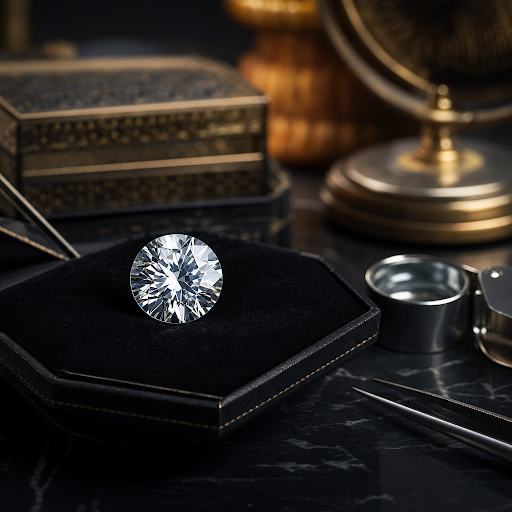
Few gemstones in human history have commanded the reverence, desire, and cultural weight that diamonds carry. From ancient Indian riverbeds to the glittering showcases of contemporary jewellers, the diamond’s journey is one of geological wonder, human ingenuity, and enduring symbolism. Whether worn as a declaration of love, a mark of status, or a personal investment, diamonds occupy a singular place in the world of fine jewellery — and understanding their story only deepens their appeal.
A Stone Forged in the Earth’s Depths
Diamonds are born under extraordinary conditions — formed roughly 100 miles beneath the Earth’s surface, where intense heat and pressure transform carbon atoms into the hardest natural substance known to science. Volcanic activity then carries these crystals upward through kimberlite pipes, where they eventually become accessible to miners. This violent, ancient origin story is part of what makes a diamond so compelling. Every stone is, in a very real sense, a relic of the planet’s deep geological past, billions of years in the making.
The earliest recorded use of diamonds dates back to India, where they were collected from alluvial deposits and prized not just for their beauty but for their supposed mystical properties. Ancient cultures believed diamonds could ward off evil, bring clarity of mind, and even grant invincibility in battle. It was only centuries later, as trade routes expanded and European royalty began acquiring these stones, that diamonds became synonymous with romantic love and matrimonial commitment.
The Art and Science of Diamond Cutting
A rough diamond, while remarkable in its own right, bears little resemblance to the brilliant, light-refracting gem we associate with fine jewellery. The transformation from raw crystal to polished stone is an art form that has evolved over centuries. Early lapidaries worked with rudimentary tools, relying on intuition and experience to reveal a stone’s inner fire. Today, master cutters use advanced technology — including laser mapping and computer modelling — to determine the precise angles and facets that will maximise a diamond’s brilliance, fire, and scintillation.
The round brilliant cut, developed in the early twentieth century, remains the most popular diamond shape precisely because it is engineered to reflect the maximum amount of light. But other cuts — the emerald, the cushion, the pear, the marquise — each carry their own aesthetic character and historical associations. Choosing a cut is not merely a technical decision; it is an expression of personality and taste.
Understanding the Four Cs
The modern framework for evaluating diamond quality — cut, colour, clarity, and carat weight — was standardised by the Gemological Institute of America in the mid-twentieth century and has since become the universal language of the diamond trade. Cut determines how well a stone interacts with light. Colour grades range from the completely colourless (the rarest and most valuable) to stones with a faint yellow or brown tint. Clarity measures the presence of internal inclusions or external blemishes. Carat weight, often misunderstood as size, actually refers to the stone’s mass. Together, these four characteristics determine a diamond’s rarity, beauty, and market value — though experienced jewellers will tell you that the interplay between them is what truly defines a stone’s character.
Diamonds in the Context of Modern Jewellery Culture
The contemporary jewellery market is more sophisticated and discerning than ever before. Consumers today are not simply purchasing a stone — they are investing in craftsmanship, provenance, and meaning. Ethical sourcing has become a central concern, with buyers increasingly seeking assurances that their diamonds have been mined and traded responsibly. The Kimberley Process, while imperfect, represented a landmark effort to eliminate conflict diamonds from the global supply chain, and many jewellers now go further, offering fully traceable stones or lab-grown alternatives for those who prioritise environmental considerations.
Alongside these ethical shifts, there has been a renaissance in bespoke and artisan jewellery design. Buyers are moving away from mass-produced pieces toward custom creations that reflect individual stories and aesthetics. This is where the expertise of a trusted jeweller becomes invaluable — not just as a vendor, but as a creative collaborator. For those exploring the world of fine diamond jewellery, Leon Diamond offers an exceptional range of handcrafted pieces, combining traditional diamond expertise with contemporary design sensibilities that speak to modern buyers seeking both quality and meaning.
The Rise of Lab-Grown Diamonds
One of the most significant developments in recent jewellery history is the emergence of lab-grown diamonds as a credible and increasingly popular alternative to mined stones. Created using either High Pressure High Temperature (HPHT) or Chemical Vapour Deposition (CVD) processes, lab-grown diamonds are chemically, physically, and optically identical to their natural counterparts. They typically cost significantly less and carry a smaller environmental footprint, making them an attractive option for a new generation of buyers. The debate between natural and lab-grown diamonds is nuanced — purists argue that the geological rarity of a natural diamond is intrinsic to its value, while proponents of lab-grown stones emphasise accessibility and sustainability. Both perspectives have merit, and the choice ultimately comes down to what a buyer values most.
Exploring the Broader World of Fine Jewellery
Diamonds, of course, do not exist in isolation. They are part of a broader, richly layered world of fine jewellery that encompasses gold, platinum, coloured gemstones, and centuries of design tradition. For those interested in exploring the intersection of precious metals and gemstones, the world of gold jewellery offers its own fascinating history and aesthetic vocabulary — one that frequently intertwines with the diamond trade in the creation of rings, necklaces, bracelets, and heirloom pieces that endure across generations.
Understanding how different materials complement one another — how a yellow gold setting can enhance the warmth of a champagne diamond, or how platinum’s cool neutrality makes a colourless stone appear even more brilliant — is part of the deeper education that comes with engaging seriously with fine jewellery.
The Historical Record: Why Diamonds Have Lasted
For those who wish to understand the full sweep of the diamond’s cultural journey — from ancient talismans to modern engagement rings — this detailed account of diamonds’ history provides an authoritative and engaging overview of how these stones have shaped human culture across millennia. The story is one of trade, conquest, romance, and reinvention — a narrative that continues to evolve with every generation of jewellers and buyers.
A Legacy Worth Investing In
What makes diamonds so persistently compelling is not simply their physical beauty or their geological rarity — it is the weight of meaning that human culture has layered upon them over thousands of years. A diamond engagement ring is not just a piece of jewellery; it is a promise, a milestone, a tangible expression of something intangible. A diamond passed down through generations carries with it the stories of those who wore it before. This capacity to hold meaning, to transcend the purely decorative, is what separates diamonds from almost every other material object.
As the jewellery industry continues to evolve — embracing new technologies, responding to shifting consumer values, and finding fresh ways to honour ancient craft traditions — the diamond remains at its centre. Whether you are purchasing your first piece of fine jewellery or adding to a lifelong collection, approaching the process with knowledge, intention, and a trusted partner makes all the difference. The diamond’s story is far from over; in many ways, it is still being written.

1 Comment
Pingback: TheTechYX.com: Exploring a Modern Technology Platform for Digital Innovation and Online Growth - lifestylesblogs.co.uk